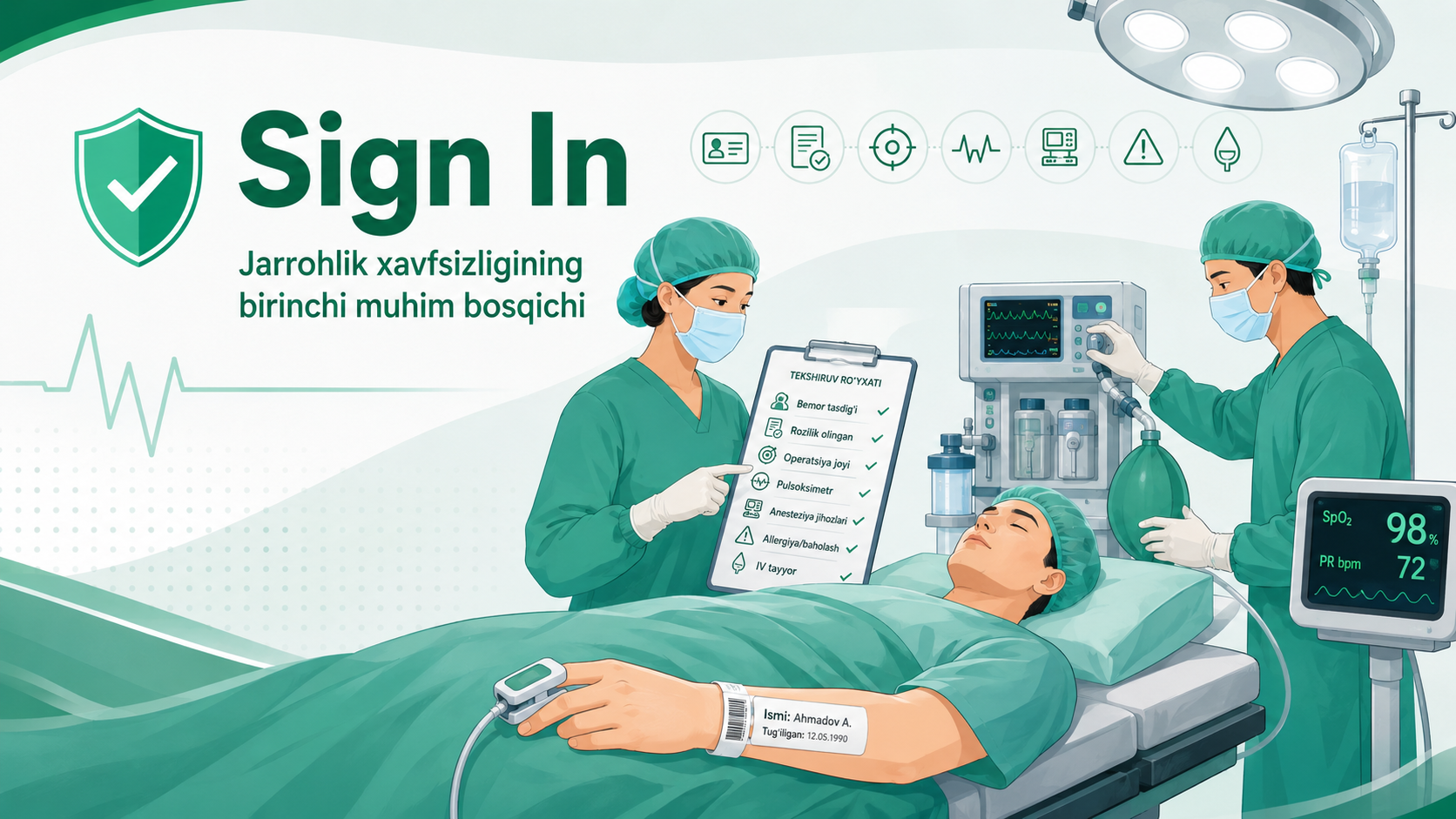
Surgery is one of the most responsible and complex processes in healthcare. A successful surgical outcome depends not only on the surgeon’s expertise, but also on the proper implementation of all organizational and clinical procedures aimed at ensuring patient safety.
For this purpose, the World Health Organization (WHO) developed the WHO Surgical Safety Checklist. The checklist is designed to reduce risks and prevent avoidable errors during surgical procedures.
The checklist consists of three main stages. The first is “Sign In”, which refers to the safety check performed before induction of anaesthesia.
When is “Sign In” performed and who takes part?
The “Sign In” stage is carried out before anaesthesia is induced. At least a nurse and an anaesthetist participate in this process.
Its main purpose is to reconfirm essential information about the patient, identify potential risk factors and assess whether the medical team is prepared to manage them before surgery begins.
The patient’s identity and planned procedure are confirmed
First, the patient’s identity, the planned surgical procedure, the surgical site and the patient’s consent are confirmed.
Although this may seem like a simple check, it plays an important role in preventing serious errors, including wrong-patient or wrong-site surgery.
When required, the surgical site is marked in advance and the marking is checked again before the procedure begins.
Anaesthesia equipment and medications are checked
An important part of “Sign In” is confirming that the anaesthesia equipment is functioning properly and that the necessary medications and other medical equipment are ready for use.
The team also confirms that a pulse oximeter is connected to the patient and functioning properly. Pulse oximetry helps monitor the patient’s blood oxygen saturation and pulse rate.
Allergies and airway-related risks are assessed
Before anaesthesia begins, the team must determine whether the patient has any known allergies. Allergic reactions to certain medications or medical materials may lead to serious complications.
The team also assesses whether there is a risk of a difficult airway or aspiration. If such a risk is identified, the medical team prepares the necessary equipment and appropriate assistance in advance.
The risk of significant blood loss is assessed in advance
During “Sign In”, the possibility of major blood loss during surgery is also evaluated.
In particular, the team assesses whether there is a risk of more than 500 ml of blood loss in an adult patient or more than 7 ml/kg in a child.
If such a risk exists, appropriate intravenous access, fluids and other necessary measures are planned in advance.
Why is “Sign In” important?
Some errors in surgical care may occur for relatively simple reasons — incomplete verification of information, insufficient communication among team members or failure to assess risks in advance.
“Sign In” helps prevent such situations. At this stage, the medical team once again reviews the most important factors that may affect patient safety before the surgical procedure begins.
For this reason, “Sign In” should not be regarded merely as a formal check, but as an important clinical mechanism for ensuring patient safety.
Surgical safety begins even before the operation itself — by making sure that the patient has been correctly identified, potential risks have been assessed and the medical team is prepared to respond appropriately to possible situations.




 IQ Tech